Disposable Paper Food Trays for Foodservice
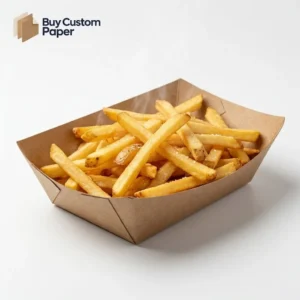
A disposable paper food tray is an open-top serving format with a base and raised sides. It portions, presents and serves food that customers eat soon after it’s prepared, which makes it a natural fit for fries, snacks and shareable sides. The open format gives customers quick access to the food, but it doesn’t contain spills the way a lidded carton does. How a tray performs depends on its paperboard, barrier, geometry and the food in it, so we build each order around your menu item and service conditions. You can also browse our full range of custom paper food trays.
Types of Custom Disposable Food Trays
We offer three tray types, each sized, printed and formed to your specification. The right one depends on your food, your portion and how your team serves it.
| Tray Type | Defining Structure | Typically Suited To | What to Specify |
|---|---|---|---|
| Boat-style | Tapered, open-top tray with sloped sides | Fries, fried snacks, nachos and other loose, scoopable foods | Base footprint, wall height and top opening |
| Rectangular | Flat-bottomed tray with a wider serving surface | Sliders, loaded sides, and bakery or deli portions | Length, width, wall depth and corner style |
| Interlocking | Folding, tab-assembled tray that folds flat for storage and is erected at service | Lighter portions where flat storage matters. Heavier or loose-fill portions may call for another type, because assembled strength is design-specific | Dimensions, wall depth and portion weight |
Whether a tray nests or stacks depends on its design, so tell us if you need that.
Available Specifications
Use this overview to see what you can specify. The sections below explain each choice.
| Specification Area | What You Can Specify | Typical Range or Options |
|---|---|---|
| Tray type | Boat-style, rectangular or interlocking | Three types |
| Dimensions | Top opening, base footprint, wall height, overall size | Roughly 4–12 in long, 2.5–10 in wide, 1–2.5 in high (100–305 × 65–255 × 25–65 mm); custom sizes outside this range can be discussed |
| Portion capacity | Nominal food weight the tray holds | About 4 oz (¼ lb) to 5 lb |
| Paper weight | Paperboard weight (GSM) | About 180–450 GSM |
| Caliper | Board thickness | About 12–24 pt (0.012–0.024 in, or 0.30–0.61 mm) |
| Base appearance | Paperboard look before printing | White or natural kraft |
| Barrier | Surface treatment for grease and moisture | Uncoated, grease-resistant or aqueous coated, PE coated |
| Printing | Colors, coverage and print sides | CMYK, Pantone (PMS) or one color; outside, inside or both |
| Forming | Cutting, creasing and corner construction | Die cut, creased, folded; corners joined or locked |
Available Sizes, Dimensions and Formats
We make trays to the dimensions you specify, in inches or millimeters. These typical ranges show where most foodservice trays fall.
| Tray Type | Typical Length | Typical Width | Typical Wall Height |
|---|---|---|---|
| Boat-style | About 4–10 in (100–255 mm) | About 2.5–6 in (65–150 mm) | About 1–2.5 in (25–65 mm) |
| Rectangular and interlocking | About 6–12 in (150–305 mm) | About 4–10 in (100–255 mm) | About 1–2.5 in (25–65 mm) |
Portion capacity. Tray capacity is usually described by the nominal weight of food the tray holds. Common classes run from ¼ lb (4 oz) through 6 oz, ½ lb, 1 lb, 2 lb, 2.5 lb and 3 lb up to 5 lb. A capacity label is a nominal weight and varies with how dense your food is. Give us your actual portion weight and we’ll match the dimensions to it.
On a tray, “length × width × height” can mean several different measurements, so please tell us which ones you’re giving us.
| Dimension | What It Means | Why It Matters | What to Tell Us |
|---|---|---|---|
| Top opening | Length and width of the opening at the rim | Determines how much food fits and how the tray sits in a bag or basket | Rim length and width |
| Base footprint | Length and width of the flat bottom | Affects stability and how much surface the food rests on | Base length and width |
| Wall height | Depth from base to rim | Affects portion size, handling and how easily customers reach the food | Height from base to rim |
| Overall external size | Outside length, width and height | Matters for storage, dispensers and counter space | Outer dimensions, if fit is critical |
| Shape and profile | Outline and wall angle, such as straight or tapered walls | Changes how the tray looks and holds food | A sketch, reference photo or existing design |
| Finished size | The assembled tray size you need | A flat blank and an assembled tray differ in size | Your finished tray dimensions, so we can confirm the construction to achieve them |
| Stacking and nesting | Whether trays are stacked or nested in storage or at service | Wall angle and design affect how trays separate and fit | How you plan to stack or nest them |
If you’re matching a specific menu item, send us the portion size or a reference photo and we’ll help you work out the right dimensions.
Paperboard Weight, Materials and Barrier Options
The right paperboard depends on your tray design, your food and how long the food sits in the tray. We customize paper weight, material and barrier to suit each application.
Paper Weight (GSM) and Caliper
GSM is grams per square meter, a measure of how much the paper weighs. Caliper is its thickness, often quoted in points (pt) in the US, where 1 pt is 0.001 inch. The two measure different things, so a GSM figure can’t be converted straight into points. Two boards with the same GSM can differ in thickness and stiffness.
| Weight Class | Typical Paper Weight | Typically Suited To |
|---|---|---|
| Light-duty | About 180–250 GSM | Smaller, lighter portions and dry or low-oil foods |
| Standard | About 250–350 GSM | Most fries, snacks and mid-weight portions |
| Heavy-duty | About 350–450 GSM | Larger, loaded or heavier portions |
Caliper across these weights is typically about 12–24 pt. A tray’s strength also depends on its fiber, barrier, wall geometry, creases and corners, and the food it carries. GSM alone doesn’t guarantee strength, stiffness or grease resistance. If you’re unsure which weight you need, describe your food, portion size and service conditions and we’ll help you specify it.
Base Paperboard and Appearance
We offer white or natural kraft paperboard, depending on the look you want before printing. Base color is separate from printed color, and it doesn’t tell you how a tray handles grease. Natural kraft and white board both need a suitable grease-resistant treatment for oily foods.
Barrier and Surface Options
Grease resistance, moisture resistance and spill containment are three different requirements. Tell us whether your food is hot, cold, oily, sauced or wet, and how long it sits in the tray. A barrier also has to hold up where the tray is creased and formed.
| Barrier or Surface | What It Does | Typically Suited To | What to Tell Us |
|---|---|---|---|
| Uncoated board | Adds no barrier | Dry, non-oily foods and short service | Food type and service time |
| Grease-resistant or aqueous-coated board | Resists oil penetration; water-based coatings add some moisture resistance | Fries, fried snacks and lightly sauced foods | Oil level, seasoning and hold time |
| PE-coated or laminated board | Stronger moisture and liquid barrier | Wetter or more heavily sauced foods | Sauces, toppings, steam and hold time |
Barrier choice depends on the construction you select, and it doesn’t make an open tray leakproof. Heat and hold time also affect which construction suits, so share your serving temperature.
Printing and Branding
We offer custom printed food trays so your trays carry your brand. Add a logo, brand colors, a repeat pattern or promotional artwork, or order unprinted trays for a plain look. Ink, print position, paperboard, barrier and tray forming all have to work together, so we match the print to the construction you choose. We confirm your design, artwork and tray specification with you for approval before production.
| Printing Option | What You Can Choose | What to Consider |
|---|---|---|
| Color | CMYK full color, Pantone (PMS) spot color or one color | Contrast against white or kraft board |
| Print sides | Outside only, inside only, or inside and outside | Printed areas that may touch food depend on the ink and construction |
| Printing method | Digital, flexographic or offset printing | Matched to your quantity, artwork and board |
| Inks | Water-based and soy-based inks | Suitability for food-contact surfaces depends on the finished tray |
| Finish | Aqueous coating or varnish on outside surfaces | Specialty finishes can be discussed for presentation trays |
- Logo and Artwork: Send a vector file (AI, EPS or print-ready PDF) so we can place it on your tray’s dieline.
- Brand Colors: Share Pantone references if you need an exact brand match.
- Print Coverage: Choose a single logo, a repeat pattern or wider coverage.
- Print Location: Outside panels are the usual starting point, and inside printing is available for suitable constructions.
Cutting, Forming and Converting
Your tray’s shape comes from how the paperboard is cut and formed. Converting includes die cutting, creasing and forming, with corners joined or locked as the design requires. Walls and corners carry the most stress on a loaded tray, so geometry matters as much as board weight.
- Shape and Profile: Give us the outline and wall angle you need.
- Wall and Corner Design: Tell us what goes in the tray so we can account for load.
- Barrier Fit at Folds: Any grease or moisture barrier must suit creasing and forming.
- Existing Designs: Send a dieline or reference tray if you have one.
Applications for Custom Disposable Food Trays
The right tray depends on what you serve, how much it weighs and how long it sits. Here is how the specification choices apply to four common uses.
Fries, Fried Snacks and Sides
Fries and fried snacks are served quickly and eaten soon after they leave the fryer. Portions commonly sit in trays from about ½ lb to 3 lb, with a base and wall height that fit your portion and a board and barrier that suit the oil in your food. Boat-style trays suit loose, scoopable foods like these, and a standard 250–350 GSM board is a typical starting point. If fries are your main product, see our custom French fry trays.
Nachos, Wings and Loaded or Sauced Sides
Shareable and loaded foods put more weight and moisture on a tray than a simple snack does. Portions typically run from about 2 lb to 5 lb, in a boat-style or rectangular tray with a wider or deeper footprint, and base and corner construction matter more as the load grows. A heavier board, about 300–450 GSM, is a common choice for these loads. Heavily sauced or very wet foods are a construction question, and not every open tray can handle them. Describe your sauces, portion weight and holding time, and we’ll help you choose a suitable board and barrier.
Food Trucks, Concessions and Grab-and-Go Service
Counter handoff speed and consistency matter most here. A tray sized to your portion keeps filling quick, and branding makes your food recognizable when customers carry it away. If you buy for several locations or events, keep the same dimensions, board and artwork on record so each reorder matches.
Catering, Sampling and Tasting Service
Single-portion servings at tasting stations and events call for a footprint matched to the portion, often a small tray of about 4–6 oz, and branding that suits the occasion. We can size trays to your event portions, so give us your quantity and event dates when you request a quote. Open trays suit food served shortly after plating. For longer holding times, describe the conditions so we can discuss the right construction.
How to Choose the Right Custom Food Tray
- Start with the food and portion. Note what the tray will hold, its weight in ounces or pounds, and whether it includes sauces or oils.
- Choose the tray type and dimensions. Decide on the type, top opening, base footprint and wall height that fit your portion and counter.
- Match the paperboard to the load. Treat GSM as one input alongside tray geometry, corners and food weight.
- Set grease and moisture needs. Describe your food, how long it sits in the tray and the serving temperature.
- Plan your branding. Decide on a logo, pattern or coverage, and where it should appear.
- Confirm quantity and timing. Work out your first order, expected reorders, destination and target date.
Not sure which specification to choose? Describe your menu item and service style, and we’ll help you work it out.
Ordering and Requesting a Quote
Our pricing is competitive, and your quote reflects your tray type, dimensions, construction, printing and order quantity. To help us quote accurately, include:
- Food and Portion: What the tray holds and its typical weight.
- Tray Type or Reference: The type you want, or a photo, sample or existing design.
- Dimensions: Top opening, base footprint and wall height, in inches or millimeters.
- Material and Appearance: Preferred paperboard look and weight, if known.
- Grease and Moisture Needs: Food condition, contact time and serving temperature.
- Artwork: Logo or design file, brand colors and print coverage.
- Quantity and Reorders: Your first order and expected repeat volume.
- Destination and Date: Your delivery ZIP code and when you need the trays.
- Documentation Needs: Any food-contact documentation you require.
Minimum Order Quantity: 500 trays.
Delivery Timeframe: 8–13 days after design, artwork and specification approval.
Request a Custom Food Tray Quote
Food-Contact Suitability and Documentation
We provide FDA-approved, food-grade, food-contact paper for foodservice applications. FDA food-contact requirements apply to each component of a finished tray and to how the tray is used. Those components include the paperboard, any grease-resistant treatment, inks and adhesives. So we confirm suitability for the construction and conditions you select rather than assuming it for every food, temperature or contact time. Include your food type and any documentation requirements in your quote request, and we’ll discuss what applies to your tray.