Custom food packaging from Buy Custom Paper covers printed, customizable paper for food businesses, including wrapping paper, liners, and other food-service papers. Each paper suits a different job, from wrapping a sandwich to lining a basket. You can customize paper weight, sheet or roll size, material, printing, and converting. Browse the product groups below, or send your requirements for a quote.
Custom food paper is not one product. A construction that suits a dry pastry may not suit a greasy burger, so start with the group closest to your menu and open the dedicated page for product-specific details.
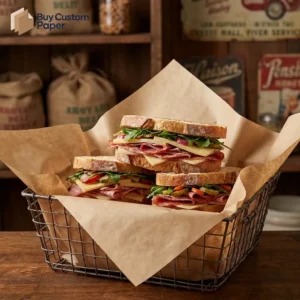
These papers wrap and present sandwiches, subs, and other suitable deli foods, and they suit branded counter service. See Custom Sandwich Paper for product-specific sizes, weights, and formats. Deli paper is not a universal substitute for greaseproof or wax-treated paper, so match the construction to the filling.
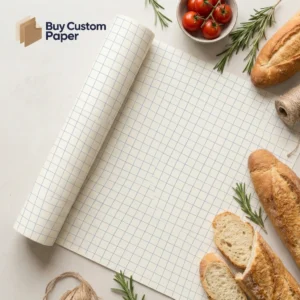
Wax describes a treatment, while grease resistance describes a performance property that can come from several constructions. For continuous dispensing, see Custom Wax Paper Rolls. Wax paper should not be assumed oven-safe, and grease resistance varies by grade.
Request a Custom Quote
Food paper can be customized in several independent ways: weight, size, format, material, printing, and converting. A printed design does not make paper grease-resistant, and a roll is a format, not a coating. The tables below show documented examples and customization possibilities. Not every option can be combined with every other, and compatibility is confirmed for your specification.
GSM (grams per square meter) measures paper mass per unit area. It does not directly measure thickness, stiffness, grease resistance, wet strength, or heat suitability, which depend on the paper grade and finished construction. Weight can be specified in GSM or in pounds (#), so include whichever your team uses when you request a quote.
| Paper product | GSM range | Basis | Selection consideration |
| Sandwich paper | 18–60 GSM | Range listed for sandwich paper | Lighter weights for simple wrapping and liners; heavier weights for more demanding handling |
| Wax paper rolls | 25–40 GSM | Range listed for wax paper rolls | Applies to wax-treated roll formats |
| Other food papers | Custom GSM | Custom request | Required grade depends on the product and application |
These ranges describe the products named and do not apply across the whole collection.
Pre-cut sheets suit manual wrapping and portioning. Rolls suit counter dispensing and can be perforated for tear-off portions. When specifying dimensions, state whether you mean cut size or usable finished size.
| Sheet size | Typical application |
|---|---|
| 6 × 6 in | Compact portions and liners |
| 6 × 8 in | Smaller wraps |
| 7 × 10 in | Small sandwiches |
| 8 × 8 in | Compact basket liners |
| 10 × 10 in | Smaller wraps and liners |
| 10 × 12 in | Larger sandwiches |
| 12 × 12 in | General wrapping and lining |
| 12 × 16.5 in | Larger wraps and lining |
| 14 × 14 in | Larger portions |
| Custom dimensions | Nonstandard products, trays, and baskets, specified in your quote |
| Roll attribute | Documented example | Product | Selection consideration |
| Roll width | 6–24 in | Sandwich paper | Match to your wrapping station or dispenser |
| Roll width | 12, 15, and 18 in | Wax paper rolls | Listed separately for wax rolls |
| Roll length | 200–1,000 ft | Sandwich paper | Balance fewer roll changes against handling and storage |
| Core diameter | 1, 1.5, and 3 in | Sandwich paper | Confirm fit with your dispenser |
| Perforation | Available for suitable rolls | Roll formats | Spacing and tear quality should fit the use |
| Custom width or length | Custom request | All roll formats | Specify in your quote |
Not every width, length, core, coating, and GSM can be combined.
The base paper, any treatment or coating, and the printing are separate layers of the finished product. Wax is not one interchangeable substance. Different formulations can differ in moisture resistance, release, and suitability for the intended contact conditions. Describe your food and use conditions in your request so the construction can be matched to them.
| Material or construction | Main property | Potential use | Limitation |
| Uncoated paper | Base-paper properties, potentially breathable | Dry or otherwise suitable applications | Confirm contact suitability |
| Grease-resistant paper | Resists oil penetration | Wrapping or lining greasy foods | Performance varies by grade |
| Wax-treated paper | Can improve moisture resistance and release | Selected wrapping and separating uses | Not automatically waterproof, oven-safe, or heat-safe |
| Kraft paper | Natural-brown paper grade, also made in white | Branding and selected wrapping uses | Appearance does not establish food-contact suitability |
| Parchment paper | Release-oriented properties | Selected baking and preparation uses | Confirm exact heat suitability |
| Silicone-treated paper | Release and non-stick behavior | Release-oriented uses | Not a universal replacement for wax paper |
| Polymer-coated paper | Added barrier properties | Applications needing a specified barrier | Coating and contact suitability are construction-specific |
| Paperboard | Structural stiffness | Trays and formed packaging | A separate product family from wrapping paper |
Base paper is available in white and natural kraft appearances, and other base colors can be discussed per product.
| Wax option | Description | Selection consideration |
| Paraffin wax | The most widely used wax for waxed food paper | Softens under heat, so it is not assumed oven-safe |
| Microcrystalline wax | Often blended in to improve flexibility and adhesion | Used in blends rather than as a stand-alone default |
| Wax blends | Combinations tuned for the intended use | Composition is matched to your application |
| One-sided coating | Wax on one face only | Suits wrapping where only one face needs the barrier |
| Two-sided coating | Wax on both faces | Greater moisture resistance, depending on construction |
| Dry wax finish | Surface wax with a drier feel | Common for deli and sandwich sheets |
| Wet wax finish | Wax saturates the sheet, giving a glossier look | Higher moisture resistance, depending on construction |
Wax type, coating side, and finish are chosen to suit your food and use conditions. Food-contact suitability is confirmed for the exact construction. Wax-coated paper should not be assumed to be oven-safe or microwave-safe.
| Property | What to know |
| Grease resistance | Depends on paper grade, food oil content, and contact time. It is often specified by test rating, so ask whether test data is available for your selected paper |
| Moisture resistance | Not the same as waterproof performance |
| Heat, oven, and freezer suitability | Must be confirmed for the exact construction, temperature, and duration |
| Microwave suitability | Cannot be inferred from a general food-grade description |
| Recyclability and compostability | Depend on the finished construction, coatings, inks, and local rules |
Printing and Branding Options
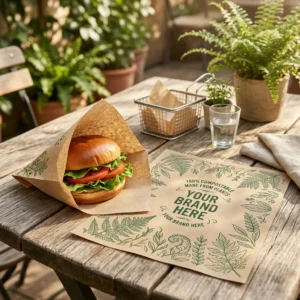
Printed food paper puts your brand on every wrap, liner, and basket. Share your logo, colors, and placement preferences, and the printing method is confirmed against your paper and run size.
| Option | Available configurations | What to specify | Qualification |
| Printing process | Flexographic, digital, or offset, where suitable | Product and expected quantity | Not every process fits every substrate |
| Color setup | One-color, multicolor, or CMYK where supported | Brand colors and Pantone/PMS references | Final appearance depends on substrate and process |
| Print sides | One-sided or two-sided, where relevant | Which sides carry the design | Confirm the food-contact arrangement |
| Artwork style | Logo, repeating pattern, or full design | Placement, spacing, and direction | Exact appearance is not guaranteed |
| Proofing | Artwork review and approval | Layout, spelling, and color intent | A proof is not regulatory approval |
Print-ready artwork is preferred. Vector files (AI, EPS, or print-ready PDF) give the best results, and raster artwork should be supplied at a suitable resolution for the finished print size. The printing method is matched to your paper and run size.
Cutting, Converting, and Finishing
Converting turns base paper into the format your team can use, from flat sheets to perforated rolls and custom shapes.
| Process | Purpose | Format | Selection note |
| Sheet cutting | Produces flat sheets | Sheets | Confirm finished dimensions |
| Slitting | Produces narrower rolls | Rolls | Width depends on equipment and grade |
| Rewinding | Creates finished roll configurations | Rolls | Confirm core and roll specifications |
| Perforation | Creates tear-off portions | Suitable rolls | Pattern should fit the use |
| Interleaving | Separates sheets for handling | Sheets | Useful for dispensing |
| Die cutting | Creates custom shapes | Liners and shaped pieces | Needs compatible material and tooling |
| Wax or functional coating | Adds a surface treatment | Compatible constructions | Suitability must be established for the application |
| Lamination | Combines layers | Selected specialty products | Not a default finish for food papers |
Decorative finishes used on paperboard, such as foil stamping or embossing, are construction-dependent and are discussed per project rather than assumed for thin wrapping paper.
[Get a Quote for Your Specifications]
Restaurants and quick-service operations use paper to wrap burgers and sandwiches, line baskets, and present takeaway meals. Grease resistance and easy handling matter most, so choose the construction by the food’s oil and moisture content. Pre-cut sheets suit manual service, while rolls can feed a continuous preparation station. Confirm suitability for the food’s temperature and expected contact time before ordering.
Delis wrap prepared sandwiches, subs, and suitable cold cuts, so sheet size must allow enough overlap to wrap fully. Fillings add moisture and grease, which should guide the paper construction. Printed logos or repeating patterns keep counter service on-brand. Check direct food-contact suitability for the exact paper and ink combination, and see Custom Sandwich Paper for related formats.
Bakeries use paper to wrap pastries, separate baked goods, and line trays for takeaway. Wrapping paper and release-oriented parchment do different jobs, so identify whether you need grease management, baking release, or post-bake presentation. Size sheets to your typical product. If oven use is intended, confirm oven suitability for the exact product, since general food wrap should not be assumed oven-safe.
Cafés wrap breakfast sandwiches, pastries, and snacks in high-frequency takeaway service. Lighter papers may suit dry items, while oily or moist foods may call for a more suitable grease-resistant construction. Practical sheet sizes and branded printing support fast, consistent service. Confirm heat and moisture suitability for warm menu items.
Food trucks need fast, handheld-friendly wrapping at compact workstations. Pre-cut sheets simplify portioning, while suitable rolls save space. Match the construction to your menu and to the time between wrapping and eating. Review the minimum order quantity of 500 sheets for sheet formats early, since roll minimums are confirmed per configuration in your quote.
Caterers wrap or separate portions for events, boxed meals, and institutional service. Standardized sheet sizes keep packing repeatable, and custom branding suits corporate or branded events. Plan quantities around your service date and check that the 8–13-day delivery timeframe fits your schedule. Paper selection should still reflect the food and its contact conditions.
Meat counters and specialty retailers wrap or separate products such as meat and other fresh items. Papers such as butcher, wax, and freezer paper are not equivalent, and each serves a different handling or preservation purpose. Choose by food, moisture and fat exposure, storage, and handling needs. Confirm direct-contact and cold-storage suitability for the exact construction before relying on it.
Food brands use custom paper to keep a consistent identity across retail, takeaway, and food-service packaging. Decide first whether the paper wraps food directly, separates portions, lines a surface, or acts as an outer package, then match material and format to that role. Coordinate dimensions, artwork, and food-contact requirements before approving production. Keeping approved specifications on file supports consistent repeat orders where the process allows.
The right paper comes from a handful of practical questions. You do not need every answer to request a quote, and “not sure” is a fine response.
These are prompts, not fixed recommendations. Send what you know with your request.
Discuss Your Food Packaging Requirements
Buy Custom Paper provides food-grade, food-contact paper options intended for specified food-packaging applications. Suitability depends on the paper construction, coatings, inks, food type, and conditions of use, not on a single label. FDA requirements for paper and paperboard food-contact components, such as 21 CFR §§ 176.170 and 176.180, apply according to the intended use.
Requirements can differ for fatty, aqueous, and dry foods, and for hot, cold, oven, or microwave conditions. A general food-grade description does not establish oven, freezer, or microwave suitability. Ask for the documentation that applies to your selected construction, including its materials, coatings, and inks, before finalizing an order.
The minimum order quantity for paper products is 500. For sheet formats, this means 500 sheets. For roll formats, the minimum is confirmed against your roll configuration in your quote. As is standard for custom printed paper, the delivered quantity may vary by up to ±10% over or under the quantity ordered. Pricing depends on paper grade, GSM, dimensions, roll configuration, coating, print complexity, converting, and quantity, so your quote reflects your exact specification.
Delivery is 8–13 days. Your quote confirms the timeline for your product, order, and destination. If you have a fixed event or launch date, include it in your request.
To get an accurate quote, prepare:
A proof lets you check artwork layout and print details before production. It does not verify food-contact compliance. For repeat orders, keeping approved specifications and artwork on record helps maintain consistency.
Request Your Custom Food Packaging Quote
Wrapping papers, liners, and related food-service papers.
Yes. Standard sheet sizes are available, and custom sizes can be requested. Documented weight examples include 18–60 GSM for sandwich paper and 25–40 GSM for wax rolls. Final options depend on the product and construction.
The MOQ is 500 for paper products, which means 500 sheets for sheet formats. For rolls, the minimum is confirmed per roll configuration in your quote. Delivered quantities can vary by up to ±10%, as is standard for custom printed paper.
Delivery is 8–13 days. Your quote confirms the timeline for your order.
It depends on the exact construction, inks, food type, and conditions of use. Request the documentation for your selected product.
Ask when you request a quote. Documentation relates to the specific materials, coatings, and inks of the construction you choose.
Not automatically. Wax can soften under heat, so confirm suitability for your exact temperature and duration. Release-treated papers such as parchment are designed for different uses, and their suitability should also be confirmed for your exact conditions.
Your application, material preference if known, dimensions, quantity, artwork, and destination. Technical fields can be marked “not sure.”